
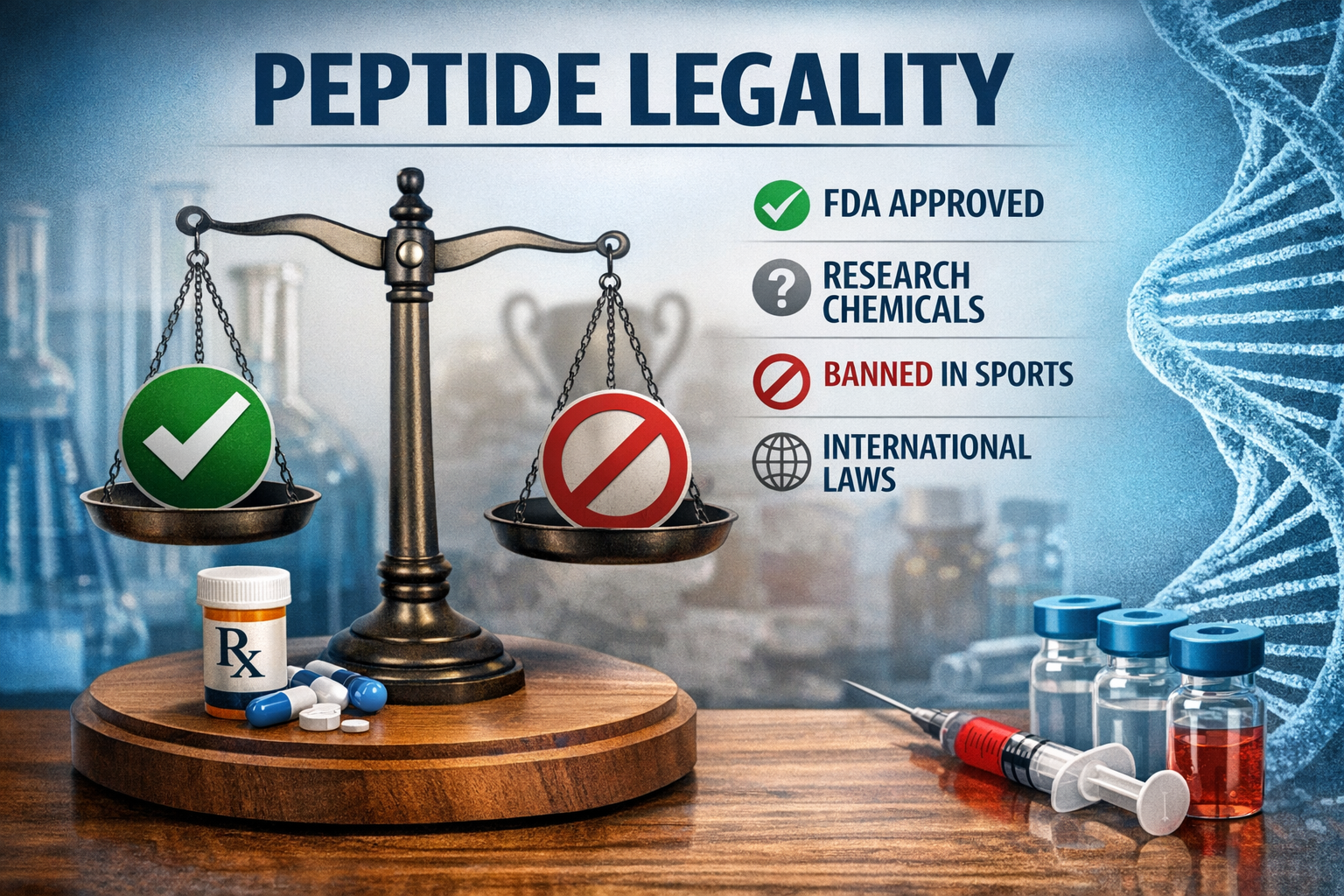
If you’re researching peptides, one of the first questions that probably came to mind is: are these even legal?
It’s a fair question, especially given how often you’ll see peptides sold as “research chemicals” with disclaimers like “not for human consumption.” The legal landscape around peptides is complicated, varies significantly by location and peptide type, and sits in a regulatory gray area that confuses even experienced users.
So, are peptides legal in the United States? This guide breaks down the legal status of peptides in the United States and internationally, what you need to know about purchasing and possessing them, and where the regulations might be heading.
Are Peptides Legal in the United States?
Most peptides exist in a legal gray zone. Some are FDA-approved prescription medications. Most are not approved for human use but are not explicitly illegal to possess for personal use. A few are controlled substances or banned in specific contexts like competitive sports.
The legality depends on:
- Which specific peptide you’re talking about
- How it’s being sold and marketed
- What you’re using it for
- Where you live
- Whether you’re a competitive athlete
Let’s break this down.
FDA-Approved Peptides
Some peptides are fully legal, FDA-approved prescription medications. These have gone through clinical trials, have established safety profiles, and are prescribed by physicians for specific medical conditions.
Examples of FDA-approved peptide medications:
Insulin – Used for diabetes management since the 1920s. Peptide hormone, tightly regulated, requires prescription.
GLP-1 receptor agonists – Semaglutide (Ozempic, Wegovy) and tirzepatide (Mounjaro, Zepbound) for type 2 diabetes and weight management. These are among the most mainstream peptide medications currently available.
Growth hormone (somatropin) – Approved for specific medical conditions like growth hormone deficiency, not for anti-aging or performance enhancement.
Thymosin alpha-1 – Approved in some countries for immune support, though not in the US.
If a peptide is FDA-approved and you have a legitimate prescription, it’s completely legal. The issue arises with everything else.
Research Peptides: The Gray Area
The majority of peptides people discuss online—BPC-157, TB-500, CJC-1295, ipamorelin, and many others—are not FDA-approved for human use.
How are they sold legally?
These peptides are typically sold as “research chemicals” with explicit disclaimers stating they are “for laboratory research only” and “not for human consumption.”
This creates a legal workaround. Companies can sell these compounds because they’re marketed for research purposes, not as drugs for human use. Buyers, in turn, purchase them knowing full well they intend to use them personally.
Is this legal?
Technically, purchasing and possessing research peptides for personal use in the United States is not explicitly illegal in most cases. You’re not violating federal drug laws simply by owning them.
However:
- It’s illegal for companies to market them for human use
- It’s illegal to sell them as dietary supplements
- Using them on yourself is done at your own risk, outside of any regulatory protection
- If you’re providing them to others or selling them, you could face legal consequences
The practical reality: Many people buy research peptides online, use them personally, and face no legal issues. But this exists in a space that’s not clearly protected or endorsed by law.
Peptides and Controlled Substances
Some peptides are more restricted than others.
Growth hormone releasing peptides (GHRPs) and similar compounds that stimulate growth hormone production are not classified as controlled substances under the federal Controlled Substances Act. However, their legal status can be murky, and some states have additional restrictions.
Certain peptides may be classified differently depending on jurisdiction. It’s worth researching your specific state laws if you’re concerned.
Peptides in Competitive Sports
If you’re an athlete subject to drug testing, peptide use is almost certainly prohibited.
The World Anti-Doping Agency (WADA) maintains a prohibited list that includes a wide range of peptides, particularly those that:
- Stimulate growth hormone release
- Enhance performance or recovery
- Mimic the effects of banned substances
Examples of banned peptides:
- Growth hormone secretagogues (ipamorelin, CJC-1295, MK-677)
- TB-500 and BPC-157 (healing peptides)
- IGF-1 and related peptides
Athletes in professional, collegiate, and Olympic sports have been suspended or sanctioned for testing positive for prohibited peptides. If you compete at any level where drug testing occurs, assume peptides are not allowed unless explicitly stated otherwise.
International Legal Status
Peptide regulations vary significantly by country.
Australia: Peptides like BPC-157 and TB-500 are classified as Schedule 4 prescription-only medicines. Possessing them without a prescription can result in legal penalties.
Canada: Similar gray area to the US. Not explicitly illegal to possess for personal use, but cannot be sold for human consumption.
United Kingdom: Many peptides are unregulated, though some fall under the Medicines Act. Possession for personal use is generally not prosecuted, but selling them as medicines is illegal.
European Union: Varies by country. Some nations have stricter pharmaceutical regulations that effectively ban unapproved peptides.
If you’re outside the United States, research your local laws carefully. What’s tolerated in one country may be restricted or illegal in another.
What About Compounding Pharmacies?
Some people obtain peptides through compounding pharmacies, which create custom formulations of medications under a doctor’s supervision.
Is this legal?
Yes, if done properly. Compounding pharmacies can legally prepare peptide formulations if prescribed by a licensed physician for a legitimate medical purpose.
However, the FDA has cracked down on compounding pharmacies that produce peptides in large quantities or market them broadly without proper oversight. This is an area of active regulatory scrutiny.
If you’re getting peptides through a compounding pharmacy, make sure:
- You have a legitimate prescription
- The pharmacy is licensed and reputable
- The peptide is being used for an appropriate medical purpose
Could Regulations Change?
Yes. The regulatory landscape around peptides is evolving.
Potential future changes:
Increased FDA enforcement – The FDA could crack down more aggressively on companies selling research peptides, especially if marketed for human use.
Reclassification of specific peptides – Some peptides could be reclassified as controlled substances or explicitly banned.
Mainstream approval of popular peptides – If peptides like BPC-157 or TB-500 go through clinical trials and gain FDA approval, they’d become legal prescription medications (but likely more expensive and harder to access).
The growing popularity of peptides means regulators are paying more attention. It’s possible the gray area will narrow over time.
The Bottom Line
Peptides exist in a complicated legal space that depends heavily on which peptide, how it’s sold, and what you’re using it for.
What’s clearly legal:
- FDA-approved peptide medications with a prescription
- Purchasing research peptides for actual laboratory research
What’s in a gray area:
- Buying research peptides for personal use
- Possessing them without intent to distribute
What’s clearly illegal:
- Selling peptides marketed for human use without FDA approval
- Using banned peptides as a competitive athlete
- Distributing peptides to others
If you’re considering peptides, understand that you’re operating in a space with legal ambiguity. Most people who use research peptides personally do not face legal consequences, but there’s no guarantee that won’t change.
As always, consult with a legal professional if you have specific concerns about your situation.