
If you’ve been researching recovery peptides, you’ve probably come across BPC-157.
It’s frequently mentioned in discussions about tendon healing, injury recovery, gut repair, and even nerve regeneration. Some people describe it as one of the most promising experimental peptides available.
But what does the research actually say?
And what should you understand before considering it?
If you’re new to peptides in general, you may want to start with our guide to what peptides are and how they work before diving deeper.
This article breaks down what BPC-157 is, how it’s thought to work, what the evidence shows, potential risks, dosing considerations, and its legal status.
What Is BPC-157?
BPC-157 stands for Body Protection Compound-157.
It’s a synthetic peptide derived from a protein found in human gastric juice. (For technical readers, see this review on peptide research in the medical literature: https://www.ncbi.nlm.nih.gov/pmc/articles/PMC10292249/.)
BPC-157 is made up of 15 amino acids and was originally studied for its effects on gut protection and ulcer healing. Over time, research expanded into areas like tendon repair, muscle healing, nerve regeneration, and angiogenesis (formation of new blood vessels).
Important distinction:
BPC-157 is not an FDA-approved medication. It is sold primarily as a research peptide.
How Does BPC-157 Work?
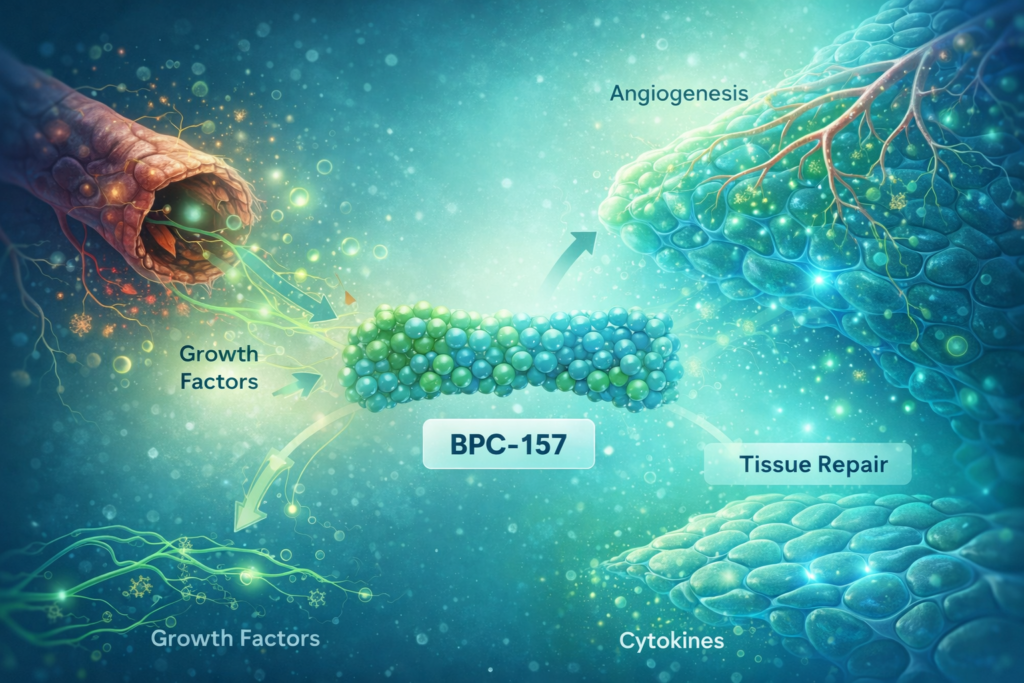
Most proposed mechanisms come from animal and laboratory research.
Potential effects include:
Angiogenesis stimulation
BPC-157 appears to promote the formation of new blood vessels. This may help deliver nutrients and oxygen to damaged tissue.
Growth factor modulation
Some research suggests it influences growth factors involved in tissue repair.
Anti-inflammatory signaling
Studies indicate it may reduce excessive inflammation in injury models.
Gut lining protection
Early research focused on its ability to protect and repair the gastrointestinal lining.
Much of this research has been conducted in animals. Human clinical trials are extremely limited.
What Do People Use BPC-157 For?
Despite limited human trials, BPC-157 is commonly discussed for:
- Tendon and ligament injuries
- Muscle tears and strains
- Joint pain
- Gut health support
- Nerve injuries
- Post-surgical recovery
Several tendon healing studies in animal models have shown accelerated repair and improved structural integrity (see: https://pubmed.ncbi.nlm.nih.gov/30915550/).
However, it’s important to separate:
- Controlled laboratory findings
- Anecdotal human reports
- Proven clinical outcomes
They are not the same.
BPC-157 vs. TB-500
BPC-157 is often compared to TB-500, another experimental peptide used for tissue repair.
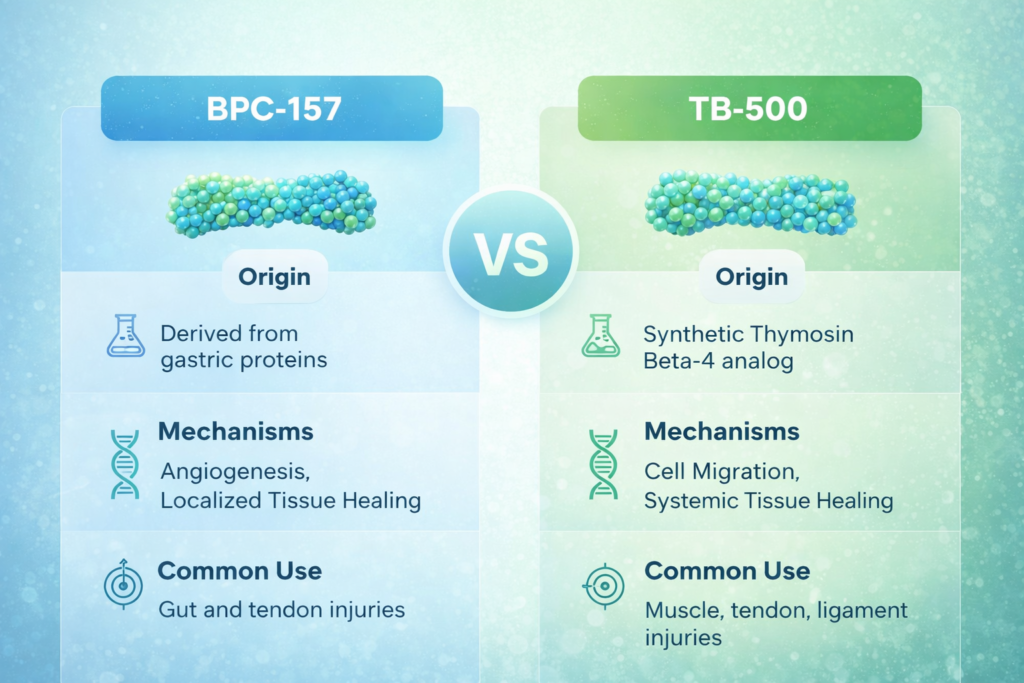
Key differences:
Origin
- BPC-157: Derived from gastric proteins
- TB-500: Synthetic version of Thymosin Beta-4
Mechanism
- BPC-157: Often associated with localized healing and gut support
- TB-500: Associated more with cell migration and systemic effects
Use patterns
- BPC-157 is frequently discussed for targeted injuries
- TB-500 is often described as more systemic
Some users “stack” them together, though there is no clinical evidence proving this combination is superior to either alone.
For broader context, you can also read our comparison of peptides vs. steroids.
What Does the Research Show?
BPC-157 has promising preclinical data.
Animal studies suggest potential benefits in:
- Tendon repair
- Ligament healing
- Muscle regeneration
- Nerve recovery
- Gastrointestinal protection
But here’s the critical reality:
- Human clinical trials are extremely limited
- Long-term safety data is absent
- Optimal human dosing is not established
- Publication bias may exist
Preclinical promise does not automatically translate to reliable human outcomes.
How Is BPC-157 Used?
BPC-157 is typically used in one of two ways:
- Subcutaneous injection
- Oral capsule (less common, absorption debated)
In research and anecdotal use, dosing protocols vary widely. Reported usage patterns often involve daily or twice-daily administration over several weeks.
Important:
There are no FDA-approved dosing guidelines. Any dosing information found online is based on user experimentation and extrapolation from animal studies, not clinical standards.
Potential Side Effects and Risks
Short-term anecdotal reports often describe BPC-157 as well tolerated. However, absence of widespread reporting does not equal proven safety.
Reported side effects include:
- Injection site irritation
- Headaches
- Fatigue
- Mild nausea
Theoretical risks:
Cell proliferation concerns
Because BPC-157 influences angiogenesis and growth factors, some experts raise theoretical concerns about effects on abnormal cell growth. This has not been proven in humans but remains an open question.
Unknown long-term safety
No long-term human safety trials exist.
Quality control issues
As a research chemical, purity and accuracy vary widely by supplier.
Anyone with a history of cancer or abnormal cell growth should approach with extreme caution.
Legal Status of BPC-157
BPC-157 is not FDA-approved for human use.
In the United States:
- It is legal to purchase as a research chemical
- It cannot legally be marketed for human consumption
- Possession for personal use is not explicitly criminalized
- There are no regulatory protections for users
For a deeper breakdown of peptide legality, see our guide to Are Peptides Legal in 2026?.
Sports Regulations
BPC-157 is listed under substances prohibited by WADA (World Anti-Doping Agency).
See the official prohibited list here: https://www.wada-ama.org/en/prohibited-list
Athletes subject to drug testing should avoid it.
Should You Try BPC-157?
That depends on your risk tolerance and goals.
You might consider it if:
- You have a chronic injury unresponsive to conventional treatment
- You understand the experimental nature
- You are not subject to drug testing
You should avoid it if:
- You want evidence-based, FDA-approved treatment
- You have a history of cancer
- You are pregnant or nursing
- You are uncomfortable with unknown long-term risks
If you are considering it, speaking with a qualified healthcare provider (https://www.mayoclinic.org/) is strongly recommended.
Start conservatively. Avoid stacking multiple peptides initially. Monitor your response carefully.
The Bottom Line
BPC-157 is one of the most discussed experimental peptides for tissue repair and gut protection.
Preclinical research is promising. Human evidence is minimal. Long-term safety remains unknown.
It may represent a potential tool in specific situations — but it is not a miracle compound, and it is not without risk.
Approach it with curiosity, caution, and realistic expectations.