

One of the biggest challenges, and risks, in the peptide space is sourcing. Learning how to source quality peptides safely is one of the most important — and overlooked — parts of navigating the peptide space.
Unlike FDA-approved medications where quality, purity, and dosing are tightly regulated, most peptides exist in an unregulated marketplace. What you order is not always what you receive.
If you’re new to the peptide landscape, it helps to first understand what peptides are and how they work before evaluating sourcing risks.
Contaminated products, underdosed vials, incorrect compounds, or even sterile water labeled as peptides have all been documented in the research chemical market.
If you’re considering peptides, understanding how to evaluate suppliers, verify quality, and avoid scams is critical for both safety and effectiveness. This guide walks through what can go wrong, how to spot red flags, and how to protect yourself. Learning how to source quality peptides properly can dramatically reduce your risk of contamination, underdosing, or counterfeit products.
Why Learning How to Source Quality Peptides Matters
Most peptides discussed online — such as BPC-157, TB-500, CJC-1295, and others — are not FDA-approved for human use. They are typically sold as “research chemicals” with disclaimers stating they are not for human consumption.
If you’re unsure how the legal framework works, you can read more in our guide on whether peptides are legal in 2026.
This creates several problems:
- No regulatory oversight – No FDA inspection ensuring manufacturing standards or accurate labeling
- No standardization – Suppliers may use different synthesis methods, storage conditions, and quality control processes
- Financial incentive to cut corners – Underdosed or counterfeit products are cheaper to produce
- Limited recourse – Because products are sold “for research,” consumer protections are weak
The reality is that the peptide market ranges from legitimate suppliers producing high-purity compounds to outright scammers selling saline in vials.
What Can Go Wrong With Poor-Quality Peptides
Underdosing or No Active Ingredient
- The vial contains far less than labeled
- Or no active peptide at all
- Results: wasted money and no effect
Contamination
- Bacterial contamination
- Endotoxins from poor manufacturing
- Heavy metals
- Risk of infection or serious illness
Wrong Compound
- You think you’re receiving one peptide but receive another
- Effects and safety profile become unpredictable
Degraded Product
- Improper storage (heat, light, humidity)
- Loss of potency over time
Incorrect Concentration
- Labeled 5mg but contains significantly more or less
- Leads to inaccurate dosing and potential side effects
This isn’t just about being ripped off. It’s about your health.
How to Source Quality Peptides Without Getting Scammed
If you see these warning signs, walk away.
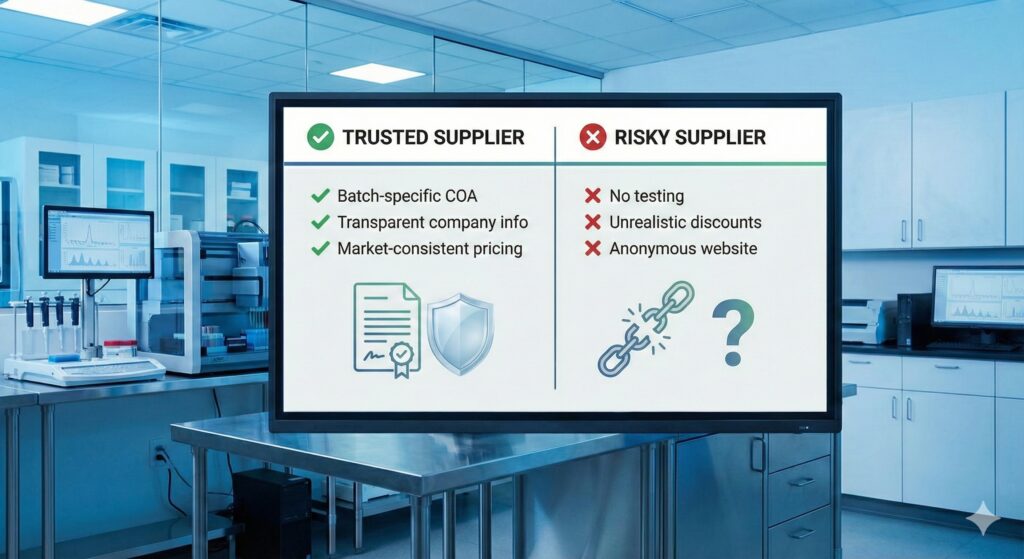
🚩 No third-party testing
If there’s no independent lab verification, assume risk. Internal testing alone isn’t sufficient.
🚩 Prices far below market
If one supplier is dramatically cheaper than everyone else, there’s usually a reason.
🚩 Overpromising or medical claims
“Guaranteed results.” “FDA-approved research peptides.” These are false or misleading.
🚩 No company transparency
No business address, no contact information, anonymous ownership.
🚩 Only irreversible payment methods
Crypto-only or wire transfers with no buyer protection.
🚩 Aggressive pressure tactics
“Limited supply.” “Last batch.” Urgency is often used to bypass scrutiny.
🚩 Suspicious review patterns
Brand-new accounts with dozens of glowing reviews posted within days.
What to Look For in a Quality Peptide Supplier
Third-Party Testing (Most Important)
A legitimate supplier should provide:
- Certificate of Analysis (COA) from an independent lab
- Batch-specific testing
- Recent testing dates
- Clear purity percentages (typically 98%+ for quality peptides)
Common testing methods include:
- HPLC (High-Performance Liquid Chromatography) – Learn more about how HPLC works here: https://www.britannica.com/science/high-performance-liquid-chromatography
- Mass Spectrometry – Overview of mass spectrometry: https://www.britannica.com/science/mass-spectrometry
Batch numbers on your vial should match the COA.
Transparent Sourcing
Suppliers should be open about:
- Manufacturing origin
- Storage conditions
- Shipping procedures
Many peptides are synthesized overseas. That’s not inherently problematic — transparency is what matters.
Professional Presentation
- Clear product descriptions
- Proper labeling
- Storage instructions
- Responsive customer support
Professional operations tend to behave professionally.
Community Reputation
Look for:
- Long-term presence in forums
- Consistent feedback over time
- How complaints are handled
Be skeptical of sudden waves of overly positive reviews.
Understanding Third-Party Testing
Third-party testing is your strongest safeguard.
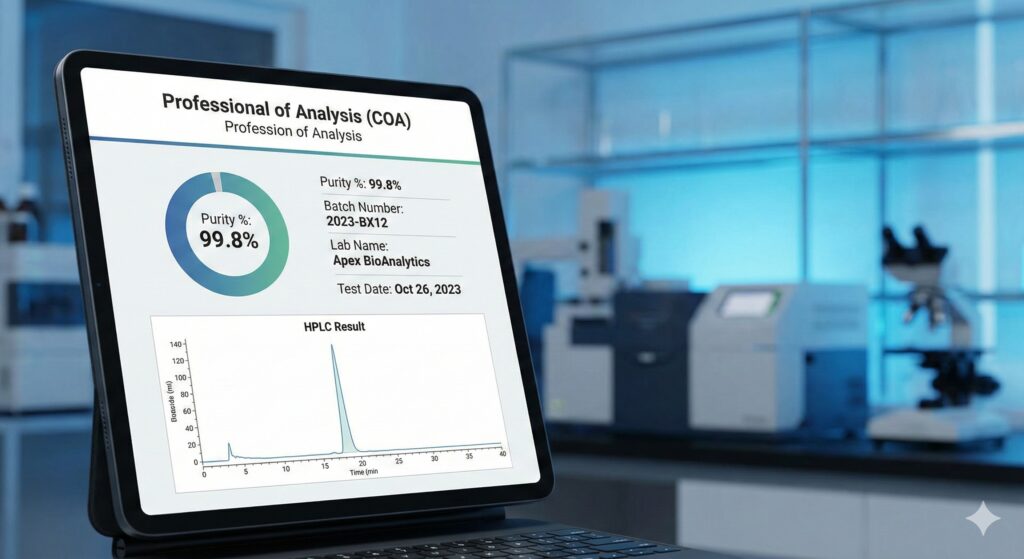
Common testing methods include:
HPLC (High-Performance Liquid Chromatography)
Confirms purity and detects impurities.
Mass Spectrometry
Confirms molecular identity.
Quantitative Analysis
Verifies actual peptide quantity in the vial.
Endotoxin Testing
Detects bacterial contamination byproducts.
Heavy Metal Testing
Screens for toxic contaminants.
A legitimate COA should include:
- Lab name and contact details
- Testing date
- Batch number
- Purity percentage
- Testing method
- Results
If unsure, contact the testing lab directly to verify authenticity.
Red flags include generic COAs, missing batch numbers, outdated reports, or suspiciously “perfect” 100% purity claims.
Evaluating Community Feedback
Online communities can provide useful information, but proceed cautiously.
Where people discuss peptide suppliers:
- Reddit (e.g., peptide-focused communities)
- Biohacking forums
- Bodybuilding forums
- Discord groups
What to look for:
- Long-term consistent feedback
- Independent testing shared by users
- Balanced reviews (not just “amazing product”)
Negative reviews are harder to fake than positive ones — weigh them carefully.
Storage and Handling
Quality depends on both supplier handling and your own storage.
Supplier Responsibilities
- Proper storage before shipping
- Secure packaging
- Temperature protection when necessary
Your Responsibilities
Lyophilized (freeze-dried) peptides:
- Store in freezer for long-term storage
- Or refrigerate for shorter-term
- Protect from moisture and light
Reconstituted peptides:
- Refrigerate
- Use within recommended timeframe
- Do not refreeze
- Protect from light
Signs of degradation include discoloration, visible particles, improper dissolution, or unusual odor.
The Compounding Pharmacy Option
Some individuals obtain peptides through licensed compounding pharmacies instead of research suppliers.
Compounding pharmacies are regulated under FDA guidance for outsourcing facilities and traditional compounders:
https://www.fda.gov/drugs/human-drug-compounding
Advantages
- Higher quality control standards
- Pharmacist oversight
- Legitimate prescription process
- Greater accountability
Disadvantages
- Requires prescription
- Higher cost
- Limited peptide selection
- Physician must be willing to prescribe
If accessible and affordable, compounding pharmacies generally offer higher quality assurance than research chemical suppliers.
However, regulatory scrutiny around peptide compounding has increased, so due diligence still matters.
Practical Steps for How to Source Quality Peptides Safely
- Research suppliers thoroughly
Compare 3–5 options. Review feedback across multiple platforms. - Verify testing
Request recent, batch-specific COAs. - Start small
Order a single vial before committing to larger purchases. - Consider independent testing
Some users send products to labs for confirmation. - Evaluate carefully
Check packaging, labeling, and reconstitution. - Reassess
Continue only if satisfied with quality and consistency.
The Legal Gray Area
Research peptides often exist in a legal gray zone.
- Typically not illegal to possess for personal use
- Cannot be marketed for human consumption
- Legal status varies by country
Understand your own comfort level with regulatory ambiguity before ordering.
Red Flags After Ordering
Stay alert even after purchase:
🚩 Delayed shipping with vague explanations
🚩 Poor packaging
🚩 No batch numbers
🚩 Product appearance inconsistent with expectations
🚩 Unresponsive customer support
If you encounter these issues, consider discontinuing use and finding a different supplier.
The Bottom Line on How to Source Quality Peptides
Sourcing quality peptides safely requires research, skepticism, and verification. There are no shortcuts.
Key principles:
- Third-party testing is essential
- Start small and verify
- Check long-term community feedback
- Store products properly
- Avoid suspiciously cheap suppliers
- Consider compounding pharmacies when possible
Until regulatory frameworks evolve, buyer verification remains critical.
If you’re serious about learning how to source quality peptides safely, verification and third-party testing should always come first.
Frequently Asked Questions on How to Source Quality Peptides
Is it legal to buy research peptides online?
In most U.S. jurisdictions, possession for personal use is not explicitly illegal, but marketing for human consumption is prohibited. Legal status varies by country.
What is a COA in peptide sourcing?
A Certificate of Analysis (COA) is an independent lab report verifying a peptide’s identity, purity, and concentration.
Are cheap peptides always fake?
Not always, but significantly below-market pricing is often a red flag for underdosing or lack of testing.